bandera
Hogar

cámara de prueba de temperatura ambiente

archivo
ETIQUETAS

cámara de prueba de temperatura ambiente

  • Lab Companion Temperature Cycling Chamber for Router Modules: Equipment Solution for Full-Link Temperature Cycling Validation of Network Devices
    Oct 17, 2026
    I. Why Router Modules Require Temperature Cycling Testing 1.1 Mechanism of Temperature Variation Impact on Signal Transmission Quality As the core unit for network data forwarding, router modules integrate switching chips, network processors, PHY chips, high-speed differential signal traces and various passive components. The core objective of temperature cycling testing for router modules is not merely verifying basic power-on functionality, but maintaining acceptable signal integrity throughout the test. High-speed differential links within router modules are highly sensitive to temperature fluctuations. During temperature cycling, thermal expansion and contraction of PCB substrates and chip packages cause minor shifts in trace impedance, degrading eye diagram performance and reducing timing margin. For Wi-Fi 6/7 wireless router modules, the gain of power amplifiers and noise figure of low-noise amplifiers in the RF front-end drift with temperature, directly resulting in fluctuating wireless throughput and elevated packet loss rate. Temperature cycling simulates operating conditions under alternating high and low temperatures to assess module performance stability and functional reliability. It effectively activates early defects introduced by soldering processes and component batch variations. 1.2 Standard Basis for Router Module Temperature Cycling Testing Temperature cycling tests on router modules comply with multiple leading international and Chinese standards, including GB/T 2423.22, IEC 60068-2-14, MIL-STD-810G and ETSI EN 300 019. These specifications define clear requirements for test conditions, procedures, duration and temperature ramp rates. Certain router product certifications mandate environmental adaptability tests under temperature cycling conditions of -40°C to +85°C with 95%RH non-condensing humidity. During testing, samples must remain powered on while key metrics such as throughput, packet loss rate and signal strength are monitored in real time to verify communication stability under changing thermal conditions. 1.3 In-line Monitoring: Core Requirement for Router Temperature Cycling Testing Temperature cycling for router modules differs fundamentally from discrete component testing. Component testing only evaluates parameter recovery after thermal exposure. As fully functional network units, router modules must sustain continuous traffic forwarding throughout the thermal cycle. Even if functionality recovers once temperature returns to normal, any mid-test throughput drop, rising packet loss or temporary disconnection indicates temperature-related latent failure risks. Therefore, temperature cycling chambers for router modules must feature in-line monitoring ports to keep samples powered inside the chamber and capture real-time throughput, bit error rate and other performance data via external test instruments. II. Key Technical Requirements for Router Module Temperature Cycling Chambers 2.1 Superior Temperature Uniformity to Ensure Consistency in Multi-Module Testing Router modules are frequently tested in batches with multiple samples loaded simultaneously. Significant temperature variance across the chamber cavity would expose samples to inconsistent thermal stress and invalidate result comparability. Lab Companion adopts dual air duct circulation and multi-point sensor layout. Under full-load operation, temperature uniformity is controlled within ≤±2.0°C, temperature fluctuation ≤±0.5°C with temperature deviation of ±2°C. This specification ensures uniform thermal stress applied to samples placed at different positions in one batch, delivering comparable and repeatable data for batch screening and sampling inspection. 2.2 Anti-Condensation Design & In-line Monitoring Cable Ports Router modules operate powered-on inside the chamber. Condensation may form on component pins and PCB surfaces during temperature recovery from low temperature, leading to short circuits of test cables and distorted measurement readings. Lab Companion, a China-based manufacturer, implements systematic anti-condensation solutions covering airflow organization, humidity regulation and chamber structural design. The viewing window uses hollow coated electrically heated glass to prevent condensation at low temperatures. Dedicated electrical cable feedthrough ports are reserved on the chamber to route test cables outside, supporting continuous powered operation and real-time performance monitoring of samples. 2.3 Stable Temperature Control for Signal Integrity under Cycling Conditions Router modules are sensitive to ambient temperature disturbances. Throughput may degrade even when port indicators remain normal. The chamber shall provide stable temperature plateaus to minimize extra test errors introduced by control fluctuations. Lab Companion uses balanced PID temperature regulation combined with fuzzy logic control algorithms to sustain stable thermal conditions during long-duration continuous cycling tests. III. Complete Temperature Cycling Solution from Lab Companion (China) 3.1 Brand Background & Manufacturing Bases Founded in 2005 and headquartered in Dongguan, Guangdong, China, Lab Companion is a Chinese National High-Tech Enterprise and Guangdong Provincial Specialized, Refined, Differential & Innovative Enterprise. With over 20 years of expertise in environmental reliability test equipment, the company operates under ISO9001, ISO14001, ISO45001 and ISO27001 management systems, and its products carry EU CE certification. Lab Companion runs three R&D and manufacturing facilities across China: Dongguan, Kunshan and Chongqing. The Dongguan headquarters serves as the R&D hub and main production site for standard models, covering a plant area of 27,286 m² with an annual output of around 1,000 environmental test chambers. 3.2 Temperature Range & Ramp Rate Options Lab Companion TC series rapid temperature cycling chambers feature a standard temperature range of -70°C to +150°C, expandable up to +180°C. The range fully meets requirements from GB/T 2423.22, IEC 60068-2-14 and covers the typical industrial-grade test envelope of -40°C ~ +85°C for router modules. Five ramp rate options are available: 5°C/min, 10°C/min, 15°C/min, 20°C/min and 25°C/min. Both linear and non-linear temperature profiles are supported to match ramp requirements from different certification standards. 3.3 In-line Monitoring Ports & Powered Test Configuration For powered temperature cycling of router modules, dedicated electrical feedthrough ports can be configured. Modules inside the chamber connect to external traffic testers and maintain packet forwarding during cycling. Throughput, packet loss rate and signal strength are captured in real time. Multi-channel temperature acquisition can be extended to synchronously monitor the temperature of core chips on modules. 3.4 Multiple Chamber Volumes & Customization Capability TC series chambers are offered in standard volumes: 34L, 64L, 100L, 180L, 340L, 600L and 1000L. Models of 80L, 150L, 225L, 408L and 800L are in stock. Custom sizes ranging from 80L up to 8000L are available. For batch testing of small-to-medium router modules, chamber size can be selected according to sample loading quantity. In-line performance monitoring projects can be equipped with cable feedthrough and anti-condensation packages upon request. 3.5 Intelligent Control System & Full Data Logging Equipped with self-developed C100 PID temperature & humidity controller integrated with fuzzy logic algorithm and a color touchscreen, the system supports multi-segment programming, automatic data logging and report generation. Temperature profiles, actual ramp rates, dwell durations and alarm logs are recorded in standardized format and exportable after tests, supporting report compilation and batch traceability. Built-in multi-layer safety protections including over-temperature protection, compressor overload protection and fan fault alarm ensure stable operation for long unattended thermal cycling runs. IV. Typical Application Scenarios Throughput Validation for Wi-Fi Routers RF component gain and noise figure drift under temperature variation for Wi-Fi 6/7 devices and cause wireless throughput fluctuation. The TC series performs temperature cycling in accordance with IEC 60068-2-14 and GB/T 2423.22. Samples stay powered on while external testers continuously record throughput to verify wireless performance stability under thermal cycling. Packet Loss Testing for Enterprise Routers Packet loss rate is a key reliability metric for enterprise routers. TC series chambers reserve cable feedthrough ports to connect in-chamber modules to external traffic testers for real-time monitoring of packet loss and transmission latency. Extended multi-channel temperature sensing supports parallel testing of multiple router units. Temperature Cycling Stress Screening for Switch Modules Switch modules share similar temperature cycling requirements with router modules. The excellent temperature uniformity of TC series ensures identical thermal stress applied on all samples, delivering repeatable results for batch screening. Reliability Validation for IoT Gateway Modules IoT gateways typically require wide operating temperature tolerance. With wide temperature range and controllable linear ramp capability, TC series reproduces thermal stress to evaluate temperature adaptability of gateway modules. V. Equipment Selection Guidelines 5.1 Temperature Uniformity for Multi-Station Parallel Testing For multi-sample concurrent testing, prioritize full-load temperature uniformity. TC series achieves ≤±2.0°C uniformity under full load to guarantee consistent stress exposure. Evaluate cavity temperature field distribution based on sample quantity and layout during selection. 5.2 In-line Monitoring Ports and Anti-Condensation Design Router temperature cycling usually requires powered operation. Confirm anti-condensation solutions and cable feedthrough availability during selection to avoid condensation-induced short circuits during low-temperature recovery. If real-time throughput and packet loss monitoring are required, define interface types and data formats of external instruments at procurement stage. 5.3 Chamber Volume and Fixture Compatibility Calculate required cavity volume based on module dimensions and batch loading quantity. Reserve extra space for cable routing for powered tests. For multi-layer rack testing of multiple units, check rack load capacity and ensure airflow is not blocked. 5.4 Standard Compliance and Test Data Traceability TC series chambers comply with IEC 60068-2-14, GB/T 2423.22 and other mainstream test standards. For certification projects, built-in data logging fully retains thermal profiles to support audit and traceability. VI. Conclusion The core challenges of temperature cycling testing for router modules lie in preserving signal integrity under powered operation, uniform thermal field control across multi-station setups, and stable performance during long continuous cycling. Manufactured by Lab Companion from China, the TC series rapid temperature cycling chambers deliver a -70°C ~ +150°C wide temperature envelope, 5~25°C/min adjustable ramp rates, ≤±0.5°C temperature fluctuation and ≤±2.0°C full-load uniformity. Combined with systematic anti-condensation solutions, in-line cable feedthrough ports and self-developed C100 control system, the chambers provide full-link reliability temperature cycling validation for Wi-Fi routers, enterprise routers, switch modules and IoT gateway modules. Technical specifications and custom configurations can be further discussed according to project test requirements.
    LEER MÁS
  • Lab Companion Custom Thermal Cycling Chamber: Customization Path for Temperature Range, Internal Volume & Dimensions, Temperature Ramp Rate and Special Functions
    Oct 16, 2026
    I. Necessity of Non-Standard Customization 1.1 Performance Limits of Standard Models Thermal cycling chambers serve as core equipment for reliability testing in electronics, semiconductors, automotive electronics, new energy and other industries. Lab Companion TC series standard thermal cycling chambers feature a standard temperature range of -70℃ to +150℃, with 5 selectable temperature ramp rates from 5℃/min to 25℃/min. Available internal volumes range from 34L up to 16,000L. Popular standard sizes including 80L, 150L, 225L, 408L and 800L are kept in stock. These configurations meet most conventional thermal cycling test requirements. Nevertheless, standard models have inherent performance boundaries. They cannot directly support test tasks when test specimens exceed the inner chamber size, when required test temperature limits go beyond the standard range, when samples need power-on operation or connection to data acquisition systems, or when tests involve flammable and explosive specimens requiring special protection. 1.2 Practical Scenarios for Non-Standard Customization Non-standard customization is not an optional add-on, but a prerequisite to valid testing execution. Typical application scenarios are listed below: New energy vehicle battery pack testing: full battery packs require testing covering -40℃ cold start and 85℃ high-temperature cycling; Semiconductor chip testing: demand for infinitely adjustable ramp rates from 1℃/min to 20℃/min to match different phases of chip testing; High heat-load testing: operating samples may generate heat up to tens of kilowatts. Standard chambers lack sufficient cooling capacity to maintain specified ramp rates under loaded conditions. Founded in 2005 and headquartered in Dongguan, Guangdong, Lab Companion is a National High-Tech Enterprise and Guangdong Provincial Specialized & Sophisticated Enterprise. With over 20 years of expertise in environmental reliability test equipment, we operate three R&D and manufacturing bases in Dongguan, Kunshan and Chongqing. We have established a full-cycle customization system covering requirement evaluation, design, production and delivery. II. Four Core Customization Dimensions for Lab Companion Thermal Cycling Chambers 2.1 Temperature Range Customization The baseline temperature range of standard TC chambers is -70℃ ~ +150℃. For aerospace and other special test applications, the low limit can be extended down to -100℃, while the upper temperature limit can reach +250℃. We have delivered proven custom units with a precise range of -78℃ ~ +150℃ to comply with GJB 150.5A military environmental test specifications. For combined temperature & humidity testing, integrated solutions covering 20%RH ~ 98%RH are available. 2.2 Internal Volume & Dimension Customization Chamber size is the most frequently requested custom item. Custom volumes from 80L to 8,000L can be engineered as requested. Our walk-in chambers start at 1,000L up to 10,000L, with further scaling available upon request. Inner chamber design takes full account of specimen outer dimensions, loading arrangement (single / multiple samples), material access methods (handcart, forklift, hoisting) and requirements for powered sample testing. Lab Companion once delivered a 20m³ extra-large custom chamber for an aerospace research institute to solve reliability testing challenges for large aerospace assemblies. Note: Standard models of 80L, 150L, 225L, 408L and 800L are in stock. 2.3 Temperature Ramp Rate Customization Standard chambers offer 5 fixed ramp rates: 5, 10, 15, 20 and 25℃/min. Customised ramp profiles can be developed per test specifications. For semiconductor projects, we have realised infinitely adjustable ramp rates from 1℃/min to 20℃/min to accommodate varied heating/cooling requirements across chip test phases. 2.4 Special Function Customization Optional dedicated functions can be integrated according to test workflows: Semiconductor applications: Nitrogen purge to prevent condensation on samples at low temperatures; High heat-load applications: dedicated thermal load matching solution to stabilise ramp rates under loaded conditions; Control & communication: RS485 and Ethernet as standard; optional OPC UA and Modbus TCP for MES connection. For semiconductor production lines, SECS/GEM protocol can be customised to enable seamless data exchange between test chambers and factory management systems; Additional options: remote monitoring, probe station interfaces and integrated data acquisition systems. III. Delivery Workflow from Requirement to Commissioning 3.1 In-depth Requirement Analysis & Technical Alignment The project starts with multiple rounds of technical discussion. Our engineers identify not only what needs testing, but also test purposes and acceptance targets. Combining test standards, specimen characteristics, test cycles and on-site factory conditions, we translate customer requirements into quantifiable technical specifications. 3.2 Concept Design & Proposal Confirmation Preliminary equipment design is generated based on requirement analysis. Core parameters to be finalised include temperature range, ramp rate profile, inner chamber dimensions, structural layout, fixture & electrical interfaces and control system functions. The proposal will undergo technical review and confirmation with customers to ensure equipment specifications fully match test demands. 3.3 Manufacturing & Factory Acceptance Testing Once the proposal is approved, production commences. Our three manufacturing bases achieve an annual capacity of more than 2,000 units. Standard models are delivered within 7–15 working days, while non-standard custom chambers can be finished within 20 working days. Before shipment, both no-load and loaded performance verifications are completed. 3.4 On-site Acceptance & Operational Training After equipment arrival, we perform installation, commissioning and on-site acceptance. Acceptance items cover temperature range and ramp rate under no-load conditions, ramp stability under loaded conditions, temperature uniformity & fluctuation, program cycle validation, communication and data acquisition verification. We also provide on-site operation training and maintenance support to secure long-term stable operation. IV. Manufacturing & Service Capabilities for Custom Thermal Cycling Chambers 4.1 Production Capacity at Dongguan Manufacturing Base The Dongguan headquarters serves as our R&D centre and primary production site for TC series chambers, with a plant area of 27,286 m² and an annual output of around 1,000 environmental test chambers. Products hold EU CE certification. Supported by the complete supply chain in the Greater Bay Area, R&D, component procurement, assembly and factory calibration are completed locally to shorten lead times. 4.2 Nationwide Service Network Sales and after-sales service centres are located in Beijing, Shanghai, Wuhan, Chengdu, Chongqing, Xi’an and Hong Kong, forming a nationwide service network with fast response for customers in the Pearl River Delta. The company operates under ISO9001, ISO14001, ISO45001 and ISO27001 management systems. The Lab Companion trademark is registered under the Madrid System, with trademark protection across 27 EU member states, UK, Canada and multiple Southeast Asian countries. 4.3 Core Hardware & Control System TC series chambers adopt cascade refrigeration with compressors from top international brands. Lab Companion’s proprietary cold balance energy-saving control technology eliminates energy waste caused by conventional simultaneous heating and cooling conflict. The controller is our self-developed C100 PID + fuzzy logic temperature & humidity control system, equipped with a colour touchscreen. It supports multi-segment programming, automatic data logging, report generation, network connection, remote monitoring and cluster management. V. Selection & Acceptance Guidelines for Non-Standard Custom Chambers 5.1 Technical Agreement Confirmation The technical agreement is the primary acceptance document for custom equipment. It must clearly define: temperature range, ramp rates (specifying no-load / loaded conditions), inner chamber dimensions and tolerances, temperature uniformity & fluctuation, communication protocols and data storage formats. For special functions such as nitrogen purge, thermal load adaptation and explosion-proof protection, implementation methods and acceptance criteria must be documented. 5.2 Acceptance Test Items Key on-site acceptance tests: Measured ramp rates under no-load conditions; Ramp rate stability verification under loaded conditions; Multi-point measurement of chamber temperature uniformity; Validation of cyclic test programs; Communication connection and data export verification. Third-party calibration in accordance with JJF 1101-2019 is recommended, with a CNAS-accredited calibration report issued. 5.3 Lead Time & After-sales Support Standard models: 7–15 working days delivery. Non-standard custom chambers: within 20 working days. Operation training and maintenance service are provided after acceptance. The equipment integrates multi-level safety alarms for overtemperature, compressor overload and fan failure to support long-duration continuous thermal cycling tests. VI. Conclusion The core value of non-standard custom thermal cycling chambers lies in the paradigm shift from “adapting tests to equipment” to “tailoring equipment for your tests”. Customised design ensures every equipment parameter precisely matches customer products, test standards and production workflows. Lab Companion TC thermal cycling chambers are built upon standard specifications: -70℃ ~ +150℃ temperature range, 5–25℃/min five-level ramp rates and 34L–16,000L volume coverage. Extended customization covers temperature range, chamber dimensions, ramp rate and dedicated special functions. Backed by Dongguan manufacturing capacity and nationwide service network, we deliver complete reliability test solutions from standard units to bespoke custom chambers for semiconductor, automotive electronics, new energy and aerospace industries. Detailed technical specifications and configurations can be further discussed according to actual test requirements.
    LEER MÁS
  • Lab Companion Temperature Cycling Test Chamber for Electronic Components: Selection Guide Focusing on Temperature Uniformity and Anti‑Condensation Design Lab Companion Temperature Cycling Test Chamber for Electronic Components: Selection Guide Focusing on Temperature Uniformity and Anti‑Condensation Design
    Oct 14, 2026
    1. Core Requirements for Temperature Cycling Test of Electronic Components 1.1 Necessity of Component‑Level Reliability Verification Electronic components including capacitors, resistors, connectors, sensors and integrated circuits serve as fundamental building blocks for all electronic devices. During service, these components are subjected to temperature variations. Divergent coefficients of thermal expansion among different materials generate cyclic thermal stress at solder joint interfaces, inside packages and material bonding interfaces under repeated temperature cycling. Long‑term stress may cause solder joint fatigue, package cracking and bond‑wire breakage. Such failures cannot be detected under ambient‑temperature tests and will only emerge under cyclic alternating thermal stress. As a fundamental reliability validation method, temperature cycling test simulates temperature fluctuations during assembly, soldering and field operation, so as to evaluate mechanical and electrical integrity of components under alternating thermal stress. Specified by JEDEC JESD22‑A104, the standard for semiconductor device temperature cycling test, typical test conditions cover the range from ‑65 °C to +150 °C, with dwell time of 10‑15 minutes, temperature transition rate ≥15 °C/min and up to 1000+ test cycles. 1.2 Special Requirements for Test Chambers for Component Testing Characterized by small dimensions, large test batch sizes and dense electrical interfaces, electronic components impose distinct requirements compared with complete‑unit or large‑assembly testing. Temperature Uniformity: Excessive temperature deviation inside the chamber creates inconsistent thermal stress across samples in one batch and increases dispersion of test results. Anti‑Condensation Performance: Condensation forming on component surfaces or pins during temperature ramp‑up from low temperature may lead to short‑circuits and deviation in electrical parameter measurement for powered‑on tests. On‑line Monitoring Compatibility: Dedicated cable ports shall be available to route test harnesses out of the chamber for powered‑on monitoring. Batch‑Loading Capability: Fixture loading efficiency and contact reliability directly determine overall test throughput. 2. Lab Companion Complete Solution for Electronic‑Component Temperature Cycling Test 2.1 Corporate Strength & Manufacturing System Lab Companion (Guangdong Hongzhan Technology Co., Ltd.), founded in 2005 in Dongguan, is a National High‑Tech Enterprise and Guangdong Specialized‑Refined‑Differential‑Innovative Enterprise with over 20‑year experience in environmental reliability test equipment. The company operates under ISO 9001, ISO 14001, ISO 45001 and ISO 27001 management systems, and its products hold CE certification for EU markets. Three manufacturing bases are located in Dongguan, Kunshan and Chongqing. The Dongguan headquarters functions as the R&D center and main production site for standard chambers, covering a plant area of 27 286 m² with an annual output of approximately 1 000 environmental test chambers. 2.2 Key Performance Specifications of Temperature Cycling Chambers Standard temperature range: ‑70 °C ~ +150 °C, expandable up to +180 °C, fully covering temperature requirements defined in JESD22‑A104 and other mainstream semiconductor temperature‑cycling standards. Available temperature ramp rates: 5 °C/min, 10 °C/min, 15 °C/min, 20 °C/min, 25 °C/min. Both linear and non‑linear temperature profiles are supported to meet ramp‑rate requirements of diverse test standards. Temperature fluctuation: ≤±0.5 °C; temperature deviation: ≤±2 °C. 2.3 Temperature Uniformity and Anti‑Condensation Design Adopting dual‑air‑duct circulation together with multi‑point temperature sensor layout, the chamber achieves temperature uniformity ≤±2 °C under full‑load condition and ≤±0.5 °C under steady‑state conditions. This minimizes thermal‑stress discrepancy among components at different positions and suppresses data dispersion for batch testing. The built‑in anti‑condensation system prevents dew formation on component pins and housings during low‑to‑high temperature ramp‑up, ensuring stable powered‑on on‑line testing. The observation window adopts multi‑layer conductive‑film tempered insulating glass with surrounding heating wires to eliminate frosting and fogging at low temperatures for clear visual sample inspection. 2.4 Chamber Volume, Fixture and System Compatibility Standard chamber volumes: 34 L, 64 L, 100 L, 180 L, 340 L, 600 L, 1000 L. Custom non‑standard volumes from 80 L to 8000 L are available. Models can be selected according to component package dimensions and batch sizes, with custom‑designed loading fixtures offered upon request. Extended multi‑channel temperature acquisition enables multi‑point chamber‑field monitoring. Dedicated cable ports are reserved for on‑line electrical‑parameter measurement. The chamber supports connection to host PCs and LIMS laboratory management systems for automatic recording and export of test curves and datasets. 3. Typical Application Scenarios Passive Components (Capacitors & Resistors) Focus validation on capacitance drift, resistance shift and solder‑joint reliability under temperature variation. Compact‑volume chambers suit high‑volume batch testing and comply with industry specifications for passive‑component temperature cycling. Connectors & Sensors Evaluate contact‑resistance variation, material aging and sensor output drift under thermal cycling. Multi‑channel temperature acquisition monitors real‑time thermal conditions around DUTs (Devices Under Test). Integrated Circuits & Semiconductor Devices Temperature range and ramp‑rate options satisfy JESD22‑A104 requirements covering consumer‑grade to automotive‑grade semiconductors, supporting continuous durability testing for up to thousands of cycles. PCB Assembly‑Level Validation Large‑volume chambers accommodate complete PCB assemblies. The programmable controller automatically executes multi‑segment complex temperature profiles for board‑level component reliability assessment. 4. Key Selection Guidelines 4.1 Match Temperature Ramp Rate with Applicable Test Standards Ramp‑rate requirements vary across component specifications. JESD22‑A104 specifies ≥15 °C/min for certain test conditions, while other industrial standards may require 5‑10 °C/min. Select ramp‑rate options strictly per applicable test specifications to avoid over‑specification or insufficient performance. 4.2 Temperature Uniformity for Batch Testing For large‑scale simultaneous testing, temperature uniformity is critical to test‑data credibility. Lab Companion chambers maintain ≤±2 °C uniformity under full‑load. For high‑precision applications, steady‑state performance can be further evaluated. 4.3 Pre‑define Fixture Requirements and Electrical Interfaces Powered‑on on‑line testing is common for electronic components. Define harness quantity and dimensions at the selection stage to confirm proper cable port sizing. Custom fixtures can be developed for specific component packages. 4.4 Balance Chamber Volume Between Throughput and Thermal‑Field Performance Determine required volume based on sample quantity per test run. Insufficient volume reduces throughput; excessively large volume increases difficulty in maintaining homogeneous thermal field. Standard‑volume models are preferred, and non‑custom solutions are applied for special test conditions. 5. Conclusion Three core indicators dominate electronic‑component temperature‑cycling testing: temperature‑field uniformity, anti‑condensation capability and batch‑sample loading performance. Lab Companion temperature cycling chambers deliver wide temperature range of ‑70 °C ~ +150 °C, multi‑step ramp rates from 5 °C/min to 25 °C/min and temperature fluctuation ≤±0.5 °C. Supported by dual‑air‑duct circulation and proven anti‑condensation technology, alongside flexible volume options ranging from 80 L to 8000 L and custom fixture services, our chambers provide complete reliability‑test solutions for semiconductors, passive components and PCB assemblies. Further technical proposals can be customized against your exact test conditions.
    LEER MÁS
  • Lab Companion Temperature‑Humidity Cycling Test Chamber: Application of Combined Temperature‑Humidity Environmental Simulation in Electronic Reliability Validation Lab Companion Temperature‑Humidity Cycling Test Chamber: Application of Combined Temperature‑Humidity Environmental Simulation in Electronic Reliability Validation
    Oct 13, 2026
    1. Why Combined Temperature‑Humidity Testing Is Critical for Reliability Validation 1.1 In‑service Products Are Exposed to Coupled Temperature and Humidity Real‑world operating conditions for electronic products never involve temperature stress in isolation. Automotive ECUs in engine compartments undergo drastic temperature swings while being subjected to high humidity from rain and snow. Energy‑storage battery systems may suffer internal condensation inside enclosures due to day‑night temperature fluctuations. Communication base stations deployed in coastal areas operate under prolonged alternating high‑temperature and high‑humidity conditions. Temperature‑humidity coupling triggers multiple failure modes: high humidity accelerates electrochemical corrosion of metal pins; condensation on circuit boards under low‑temperature & high‑humidity conditions may cause short‑circuits; repeated thermal‑humidity cycles lead to aging and cracking of sealing materials. Combined temperature‑humidity cycling test serves as a standardized validation method to replicate such real‑world service conditions. 1.2 Differences Between Coupled Temperature‑Humidity Test and Single‑factor Test Temperature‑only cycling evaluates structural integrity and electrical stability under thermal stress. Humidity‑only testing focuses on material moisture absorption, insulation performance and corrosion susceptibility. Combined testing creates far more complex test conditions. Saturated moisture‑holding capacity of air inside the chamber changes continuously with temperature. At low temperatures, air can hold far less water vapor. Poor control will result in unintended condensation or even frost formation on test samples. For instance, IEC 60068‑2‑30 defines cyclic damp‑heat testing with 12‑hour high‑temperature high‑humidity dwell followed by a 12‑hour cooling phase, intentionally generating condensation on specimen surfaces. This test imposes strict requirements on synchronized temperature‑humidity control of test equipment. 1.3 Industry Standard Requirements for Temperature‑Humidity Cycling In international standards, IEC 60068‑2‑30 specifies the general method for cyclic damp‑heat tests to assess component and equipment performance under combined high‑humidity and temperature‑cycling conditions. IEC 60068‑2‑38 describes combined temperature‑humidity cyclic testing procedures. For automotive electronics, ISO 16750‑4 defines dedicated temperature‑humidity cycling requirements for electronic units mounted at different vehicle locations. Corresponding specifications also apply to photovoltaic modules and energy‑storage systems in the new‑energy sector. 2. Core Technical Challenges of Combined Temperature‑Humidity Test Chambers 2.1 Humidity Tracking Control During Temperature Ramping Compared with pure thermal cycling chambers, the key capability of combined temperature‑humidity chambers lies in synchronous humidity tracking along programmed temperature profiles during rapid temperature changes. Take the cooling process from +85 ℃ / 85 %RH down to ‑40 ℃ as an example: saturated water‑vapor capacity drops sharply as temperature decreases. Without active humidity regulation, relative humidity inside the chamber will surge rapidly and produce unwanted condensation on samples. Excessive dehumidification, on the other hand, drives humidity below setpoints and causes non‑compliant test conditions. The control system must calculate real‑time variation of saturated moisture capacity according to temperature change rate, and dynamically adjust humidification and dehumidification output to keep relative humidity within allowable tolerances. 2.2 Condensation Management and Specimen Protection Certain standards such as IEC 60068‑2‑30 require intentional condensation to evaluate product resistance to damp heat. However, excessive condensation in most other test scenarios may trigger sample short‑circuits and distorted test results and must be properly managed. Equipment shall support configurable condensation‑control strategies, including cooling‑rate limitation, humidity‑setpoint adjustment, pre‑heating and defrost functions. Lab Companion units are equipped with standard anti‑unintended‑condensation logic to avoid unexpected dew formation on specimen surfaces during low‑temperature‑to‑high‑temperature ramps. 2.3 Humidity‑sensor Performance at Low Temperatures Conventional capacitive humidity sensors normally work reliably above 0 ℃. Below 0 ℃, frost buildup on sensor probes causes measurement drift and inaccurate readings. Test chambers shall adopt humidity‑measurement solutions with low‑temperature compensation or indirect calculation via wet‑bulb / dry‑bulb conversion for valid humidity evaluation under sub‑zero conditions. 3. Technical Solution of Lab Companion Temperature‑Humidity Cycling Test Chamber Lab Companion is a national high‑tech enterprise and Guangdong‑province‑level specialized & sophisticated enterprise based in Dongguan, Guangdong, China. 3.1 Temperature‑humidity Range & Thermal‑ramp Performance Temperature range: ‑70 ℃ ~ +150 ℃ Humidity range: 25 %RH ~ 98 %RH (at 20 ℃ ~ 85 ℃); optional low‑humidity version down to 5 %RH Temperature fluctuation: 0.5 ℃; temperature deviation: ±1.5 ℃ Humidity deviation: ±3.0 %RH (>75 %RH); ±5.0 %RH (≤75 %RH) Temperature ramp rate: 5 ℃/min, 10 ℃/min, 15 ℃/min, 20 ℃/min, 25 ℃/min; linear & non‑linear modes supported Effective rapid‑ramp working range: ‑40 ℃ ~ +85 ℃, ‑55 ℃ ~ +125 ℃ 3.2 Temperature‑humidity Conditioning System The chamber adopts balanced temperature‑humidity control. Humidification is realized by steam generation from heated water pan. Dehumidification is achieved via vapor condensation on refrigerated evaporator surfaces. Throughout thermal cycling, the controller dynamically modulates humidification‑dehumidification output based on real‑time ramp rate and humidity deviation to maintain stable humidity tracking against temperature profiles. Product link: https://www.labcompanion.cn/labcompanion_Product_2064188703.html?_v=1708161593 3.3 Chamber Volume & Mechanical Construction Standard volumes: 80 L, 150 L, 225 L, 408 L, 800 L. Standard models are available from stock. Custom volumes from 80 L up to 8000 L are supported. Inner chamber: SUS304 brushed stainless‑steel plate; outer cabinet: cold‑rolled steel with electrostatic powder coating Insulation: rigid polyurethane foam to minimize cold‑loss at low temperature and heat‑loss at high temperature Observation window: multi‑layer hollow electrically‑heated glass to prevent window condensation for clear specimen viewing 3.4 Controller & Data Management A 7‑inch color touch‑screen programmable controller with multi‑language interface supports multi‑segment profile editing. Users can configure ramp rates, humidity setpoints, dwell duration and cycle counts. Test data and curves are recorded automatically. Historical logs can be exported via USB port. Communication interfaces are provided for LIMS integration to enable automatic data upload and report generation. 4. Typical Application Scenarios Automotive Electronics For ECUs, on‑board sensors, infotainment control units and other vehicle‑borne electronics, the chamber performs temperature‑humidity cyclic aging tests complying with ISO 16750‑4, verifying circuit and component reliability under alternating damp‑heat stress. Its wide thermal range covers ‑40 ℃ ~ +125 ℃ for automotive‑grade validation. New‑energy Industry Applied to battery modules, BMS, high‑voltage connectors, on‑board chargers and other e‑powertrain components. Temperature‑humidity cycling evaluates enclosure sealing performance and insulation stability under damp‑heat alternation for new‑energy electronic reliability verification. Industrial Control Suitable for PLCs, frequency converters, industrial power supplies and other complete units to simulate high‑temperature high‑humidity industrial field conditions and validate long‑term operational reliability. Large‑volume TC/TH series accommodates full‑size equipment and supports live‑powered specimen testing. 5. Key Selection Guidelines Match temperature‑humidity specifications: Confirm required temperature and humidity parameters according to product test standards. Narrow‑range models can be selected for high‑temperature‑only high‑humidity testing to control costs. For low‑temperature high‑humidity applications, verify actual humidity‑control performance under sub‑zero conditions. Thermal ramp rate & humidity‑tracking capability: Higher ramp rates impose greater demands on humidity‑following performance. Verify humidity tolerance under target ramp‑rate conditions. For projects requiring both rapid temperature change and precise humidity control, loaded sample validation is recommended during model‑selection phase. Chamber volume & specimen compatibility: Determine chamber size based on sample dimension and quantity. Reserve extra space for wiring and fixtures for live‑powered testing. Data‑interface compatibility: Confirm communication protocol and data format in advance if integration with LIMS or MES systems is required. 6. Conclusion Major technical challenges of combined temperature‑humidity cycling testing lie in reliable humidity tracking during fast temperature transitions and controllable condensation management. Lab Companion temperature‑humidity cycling test chambers deliver a proven solution for automotive‑electronics, new‑energy and industrial‑control customers, featuring wide temperature range of ‑70 ℃ ~ +150 ℃, humidity coverage from 25 %RH to 98 %RH, multiple ramp‑rate options from 5 ℃/min to 25 ℃/min, balanced temperature‑humidity control algorithm, flexible volume customization from 80 L to 8000 L, plus robust local manufacturing and delivery capabilities based in Dongguan, China. Further configuration adjustments can be made according to specific test standards and specimen conditions.
    LEER MÁS
  • Lab Companion: From Optical Engines to Complete Systems – How Co-Packaged Optics Thermal Cycling Testing Comes to Life Lab Companion: From Optical Engines to Complete Systems – How Co-Packaged Optics Thermal Cycling Testing Comes to Life
    Oct 07, 2026
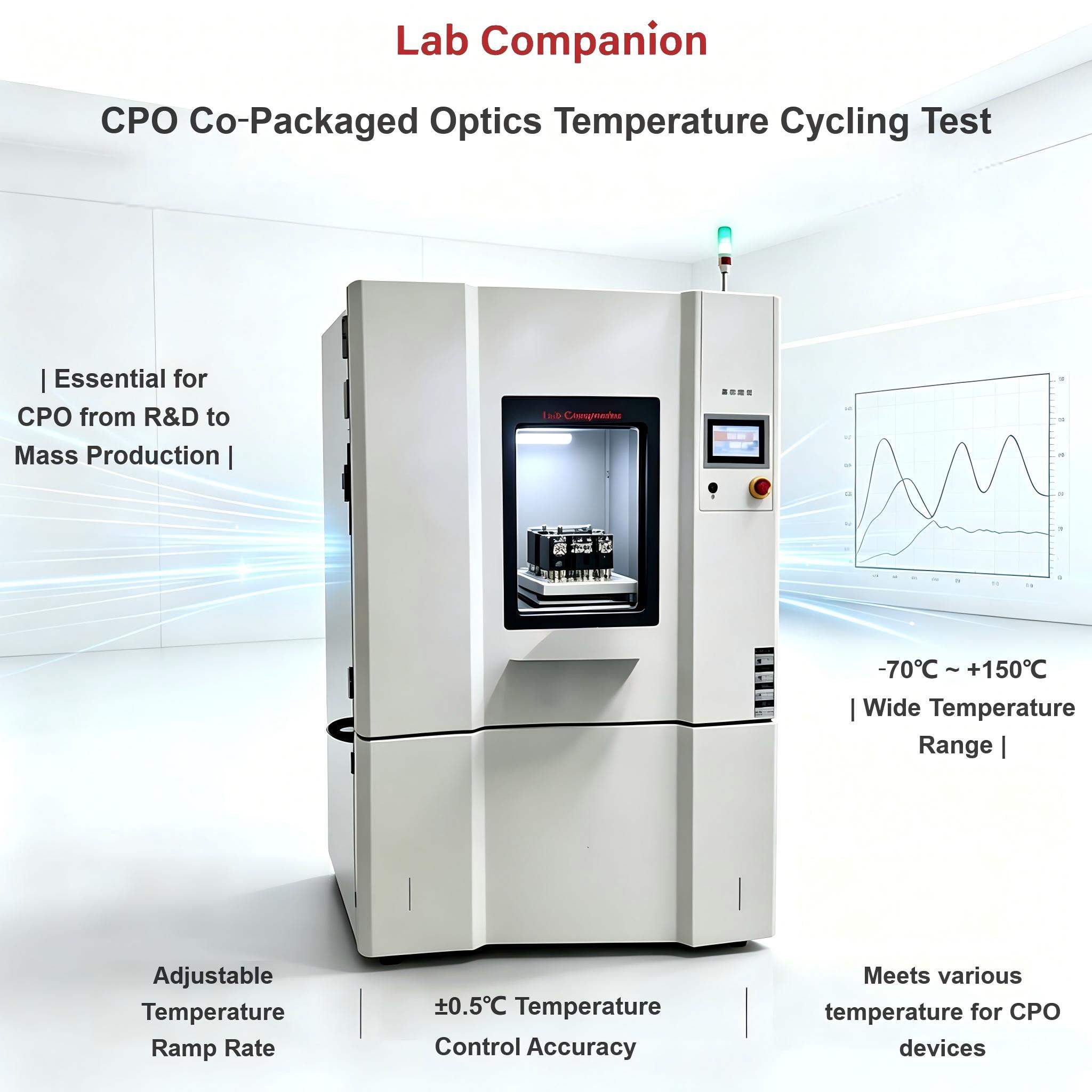
    I. CPO: From Exhibition Booth Concept to Production Line Driven by AI computing power, optical interconnection architectures are rapidly evolving from traditional pluggable optical modules toward near-packaged optics and Co-Packaged Optics (CPO). The Spectrum-X CPO switch jointly developed by NVIDIA and TSMC adopts the advanced COUPE packaging process, delivering a processing capacity of 400 Tb/s with continuous capacity expansion scheduled for the second half of the year. Domestic industries are also accelerating progress; Foxconn has rolled out prototype shipments of its CPO all-optical switches and deployed production capacity at factories across multiple regions. CPO integrates optical engines and switch chips on the same substrate, drastically shortening the optical signal transmission path and reducing transmission loss. However, high integration brings surging heat density and complex temperature stress distribution. As CPO moves out of laboratories and exhibition booths, the industry’s core focus shifts from whether the technology can be realized, to how high-reliability, low-cost mass production can be achieved. II. Upgraded Rack Interconnection: Creating a New Testing Paradigm The continuous expansion of AI clusters is reshaping the interconnection ecosystem in data centers. Take a large cluster built with 8 groups of NVL72 supporting 576 GPUs as an example: for large-scale cross-rack interconnection, traditional copper cables can no longer meet bandwidth demands. The performance bottleneck of AI systems has extended beyond the computing capability of individual accelerators to the massive data exchange and transport among chips, servers, racks, AI clusters and entire data centers. Optical interconnection keeps moving closer to compute nodes. In the future, optical signals will not only serve connections between switches and racks but also descend to the chip packaging level — and CPO stands as the core product of this trend. It detaches optical engines from pluggable modules and co-packages them with switch chips, boosting bandwidth density while cutting power consumption. Yet architectural innovation completely rewrites reliability testing logic. A faulty traditional pluggable optical module can be replaced independently; once CPO packaging is completed, optical engines and switch chips are tightly bonded. Failure of any component may lead to scrapping the entire unit, meaning the reliability of optical devices directly determines stable operation of the whole switching system. III. Three Bottlenecks for Mass Production: Interfaces, Yield and Maintainability To achieve commercial rollout, CPO must overcome three practical challenges: interfaces, yield and maintenance. On the interface side, optical interconnection imposes strict constraints on insertion loss. Industry requirements limit insertion loss of optical connections to within 0.5 dB, with coupling efficiency above 95%, and internal packaging optical loss constrained to the 1.8–3 dB range. CPO packages integrate heterogeneous materials including silicon photonic chips, active laser diodes, ceramic substrates, epoxy molding compounds and copper interconnects. The difference in coefficients of thermal expansion (CTE) between different materials can reach 2–8 times. Cyclic thermomechanical stress generated by repeated temperature cycling may trigger nanoscale displacement, causing misalignment of fiber arrays, photonic chips and coupling connectors, which directly increases optical insertion loss. In terms of yield, CPO suffers from significant yield stacking effects. Under an optimistic assumption of 95% assembly yield for a single optical engine, when one switch chip integrates 32 optical engines, the overall system yield is only approximately 19%. High packaging integration difficulty and yield loss further push up manufacturing costs. The industry generally predicts large-scale commercial application of CPO may be postponed to 2028–2029. Maintenance modes also face reconstruction. A defective traditional optical module can be replaced within minutes. In CPO, optical engines and switch chips are soldered inside the same package. If an optical engine fails, the entire board needs replacement. Silicon photonics itself features good reliability, but lasers constitute the weakest link in the link. This motivates the industry to vigorously promote external laser source schemes — placing vulnerable lasers at panel-mounted replaceable positions to reduce later maintenance costs. IV. Reliability Assessment for CPO Mass Production: Temperature Cycle Verification Compared with conventional optical modules, reliability verification standards for CPO devices are more stringent, mainly reflected in complex thermally induced failure mechanisms and high temperature sensitivity of optical parameters. On one hand, multiple thermally induced failure risks coexist. Highly integrated packaging brings high heat density and complex temperature stress distribution, easily triggering performance drift or even device failure. Rapid repeated thermal cycling can cause pump-out, cracking and mechanical fatigue of thermal interface materials, resulting in rising interfacial thermal resistance and degraded heat dissipation. Fiber coupling offset is a unique failure mode of CPO; tiny displacement caused by CTE mismatch directly degrades optical coupling performance. Besides, solder ball fatigue cracking, gold wire bonding fracture, TEC substrate debonding, interlayer delamination and substrate warpage are all typical failure modes during temperature cycling. On the other hand, optical parameters are extremely sensitive to temperature changes. Optical engines are far more temperature-sensitive than ordinary electronic devices. Taking DFB lasers as an example, the center wavelength drift coefficient is around 0.08–0.1 nm/℃. The channel spacing of mainstream DWDM systems is merely 0.8 nm. A temperature fluctuation of several degrees Celsius may shift the wavelength out of the working channel, increasing crosstalk and deteriorating bit error rate. Therefore, CPO thermal cycling testing shall not only assess structural integrity but also continuously monitor the stability of optical parameters during temperature alternation. Global industry standards set hard thresholds for test equipment. As the general benchmark for optoelectronic device reliability testing, GR-468-CORE specifies a thermal cycling range of -40℃ ~ +85℃, linear and controllable temperature ramp rate ≥10℃/min, no less than 500 cycles, and dwell time at high/low temperature ≥10 minutes. For new-generation optical modules such as 1.6T LPO, cloud vendors and operators further raise test conditions to -55℃ ~ +125℃ with temperature ramp rate exceeding 15℃/min. JEDEC JESD22-A104 and IEC 60068-2-14 are also incorporated into supplier evaluation systems. These three standards jointly form a complete certification matrix. V. Lab Companion: CPO Verification Solutions Covering Optical Engines to Complete Systems Lab Companion, located in Dongguan, is a national high-tech and specialized & sophisticated enterprise. With three R&D and manufacturing bases in Dongguan, Kunshan and Chongqing, it occupies over 6,000 ㎡ of production area and has an annual capacity of around 1,000 environmental test chambers. The company has specialized in environmental reliability test equipment for more than 20 years. To meet full-chain temperature reliability verification requirements from CPO optical engines to complete switching systems, Lab Companion has built a complete device-level to system-level equipment portfolio. Optical Engine & Module-level SolutionsThe TC Series rapid thermal cycling test chambers feature a standard temperature range of -70℃ ~ +150℃ and support rapid thermal cycling from -55℃ ~ +125℃. Five grades of loaded actual temperature ramp rates are available: 5℃/min, 10℃/min, 15℃/min, 20℃/min and 25℃/min, supporting both linear and non-linear thermal cycling modes. Within the core test range of -40℃ ~ +85℃, temperature fluctuation ≤ ±0.3℃ and temperature deviation ≤ ±2℃, satisfying the strict GR-468-CORE requirements for thermal ramp linearity and chamber temperature uniformity. Targeting the small size, high integration and high heat density of CPO optical engines, compact TC chambers deliver high-speed temperature change and excellent temperature uniformity within a small cavity. Multi-layer sample racks can be equipped to perform parallel screening of tens to hundreds of optical engines in a single batch, matching mass-production test takt time. Switching System & Complete Machine-level SolutionsWalk-in rapid thermal cycling test chambers cover volumes from 1000L to 10000L, with mechanical load capacity up to 1000kg, supporting maximum self-heating of 50kW for DUTs. Temperature range: -20℃ ~ +55℃, temperature ramp rate ≥5℃/min. The chambers can accommodate full CPO switch systems or server racks, enabling temperature cycling reliability verification under full-load operating conditions of complete machines. Production Line Adaptation & Full-process Data TraceabilityCPO mass production testing demands full traceable data. Both TC Series and Walk-in chambers are equipped with industrial touch controllers, supporting custom thermal cycle programming, real-time collection and storage of thermal curves, ramp rates, dwell duration and other key metrics. RS485 and Ethernet interfaces come as standard; OPC UA and Modbus TCP protocols are optional to connect with factory MES systems and build a full quality traceability chain. VI. Second Half of CPO Industry: Reliability Determines Competition CPO is gradually entering the mass production window, marking optical interconnection technology moving from lab validation to large-scale manufacturing. For reliability engineers in optical communication and AI computing infrastructure industries, the real competition has just begun. Solving a series of reliability challenges — insertion loss control at interfaces, yield stacking loss of optical engines, maintainability of packaged complete machines, and optical parameter stability under temperature cycling — determines how far CPO products can go from “manufacturable” toward “reliable large-scale commercialization”. From device-level rapid thermal cycling screening of optical engines to large-space loaded reliability verification of complete switch systems, Lab Companion (Guangdong Hongzhan Technology) provides integrated temperature reliability verification equipment covering device, module and complete machine for CPO manufacturers, with TC Series rapid thermal cycling chambers and Walk-in test chambers as core products. Industry forecasts project CPO penetration will rise from approximately 0.5% in 2026 to 35% by 2030. Well-equipped and reliable test equipment forms the fundamental foundation to guarantee long-term product quality.
    LEER MÁS
  • Test Object-Driven Selection Guide: Three Core Series of Lab Companion Environmental Test Chambers (Made in China) Test Object-Driven Selection Guide: Three Core Series of Lab Companion Environmental Test Chambers (Made in China)
    Sep 19, 2026
    01 Core Selection Principle: Define Your DUT First, Then Choose Equipment A common mistake in environmental test chamber procurement is prioritizing brand reputation or price before clarifying what you actually need to test. No universal test chamber fits all scenarios. Different devices under test (DUTs) — such as single chips, PCBA boards, server systems, battery packs, and automotive assemblies — require completely different chamber volume, temperature ramp rate, thermal load capacity, and stability performance. As a China-based high-end environmental testing equipment manufacturer headquartered in Dongguan, Lab Companion (established 2005) has focused on R&D, production and global sales of reliability test systems for 21 years. Our three flagship product lines — Rapid Temperature Change Chamber, Standard Temperature & Humidity Chamber, and Walk-In Environmental Chamber — are engineered for three essential testing scenarios: stress screening, performance qualification, and large-scale full-product verification. All equipment is independently developed and manufactured in China, delivering cost-effective, high-precision, and energy-efficient testing solutions for global industries. 02 Rapid Temperature Change Chamber: For High-Speed Thermal Stress Screening Core Positioning: Mass production ESS (Environmental Stress Screening) to expose early failures through fast thermal cycling. Designed for high-volume manufacturing quality control. Typical DUTs: Semiconductor chips, optical modules (800G/1.6T), PCBA circuits, automotive electronics, and precision micro-components. Widely adopted in semiconductor, optical communication, and automotive electronic production lines worldwide. Key Performance Parameters 1. Load-bearing ramp rate (genuine tested data) Most suppliers only mark no-load rate, which drops sharply after loading DUTs. Lab Companion TC series provides fully tested loaded ramp rates from 5℃/min to 25℃/min. Liquid nitrogen optional upgrade achieves 30℃/min, ensuring stable and repeatable stress screening under real working conditions. 2. Volume & mass testing capability Standard volume ranges from 80L to 800L, with customizable volumes up to 8000L. Multi-layer sample racks support simultaneous testing of hundreds of components, matching high-volume production rhythms. 3. Energy-saving & stable control Equipped with China self-developed Q8 intelligent control system and rhythmic air circulation design, power consumption is 30% lower than the industry average, enabling 7×24-hour continuous factory screening. 03 Temperature & Humidity Test Chamber: For R&D Qualification & Standard Compliance Core Positioning: High-precision environmental simulation for product performance verification, lifespan testing, incoming inspection, and certification trials. It is the most versatile standard chamber for laboratory and industrial quality control. Typical DUTs: Consumer electronics, mechanical & electrical products, medical devices, new energy components, and automotive parts. Lab Companion China-made standard chambers have been supplied to world-renowned enterprises and top universities including Valeo, Shanghai Jiao Tong University, and Chongqing Pharmaceutical Group. Key Performance Parameters 1. Wide temperature range Standard range: -70℃ ~ +180℃; customized ultra-low temperature: -80℃ ~ +200℃, covering mainstream IEC, JEDEC, and industry standards. 2. High precision & uniformity Display accuracy: ±0.1℃; control accuracy: ±0.3℃; temperature uniformity ≤ ±0.5℃. Fully compliant with JEDEC JESD22-A104 and other international reliability standards. 3. Durable industrial design Adopts stainless steel inner tank and anti-rust heavy-duty shell. Built-in convection heating system ensures uniform temperature distribution, with timing auto-shutdown and sound alarm functions for long-term stable operation. 04 Walk-In Environmental Chamber: For Large-Size & High-Power Full Product Testing Core Positioning: Customized large-volume testing solution for oversized and high-heat-load DUTs that cannot fit standard chambers. Ideal for full-module and complete machine reliability validation. Typical DUTs: New energy battery packs, vehicle interior & chassis assemblies, server cabinets, large electromechanical equipment, and solar modules. Widely used in automotive, new energy, and energy storage industries. Key Performance Parameters 1. Flexible large-volume customization Standard volume: 1000L–10000L; customized super-large space up to 100m³. Modular assembly structure adapts to various laboratory layouts worldwide. 2. High thermal load capacity Lab Companion China CW series supports 1000kg mechanical load and 50kW DUT self-heating load. Reserved liquid cooling through-wall interface solves the core industry pain point oftemperature failure caused by high-power heat dissipation. 3. Full-space temperature consistency Multi-point three-dimensional air supply design ensures temperature uniformity ≤ ±1.5℃ under full-load conditions, guaranteeing reliable and consistent test results for large components. 05 Critical Parameter Interpretation: Avoid Global Selection Pitfalls Three parameters determine test credibility, which global buyers must verify carefully: 1. Load-bearing ramp rate: Only loaded tested data is valid. Empty-speed parameters are meaningless for actual production and qualification tests. Lab Companion uniformly provides real loaded performance data. 2. Temperature uniformity: Poor uniformity leads to inconsistent stress on batch samples and invalid test conclusions, which is critical for semiconductor and high-precision electronic industries. 3. Thermal load margin: For high-power DUTs, insufficient cooling margin causes uncontrollable chamber temperature and failed tests. Lab Companion China factory strictly matches load parameters according to customer application scenarios. 06 Lab Companion China: Full Industrial Chain & Global Service Advantages Originated and manufactured inDongguan, China, Lab Companion is a national high-tech enterprise and specialized & sophisticated enterprise certified by Chinese authorities. With 21 years of environmental test equipment craftsmanship, we hold Madrid International Trademark, EU Trademark, and multiple ISO international system certificates. All products are independently designed, processed, and assembled in China, with strict quality control from raw materials to finished products. We own three major manufacturing bases in Dongguan, Kunshan and Chongqing, with an annual production capacity of over 2000 units. As a direct Chinese manufacturer without middle agents, Lab Companion delivers three core global procurement advantages: 1. Transparent cost & high cost performance: Direct factory pricing, higher configuration and more stable quality than peer foreign brands at the same budget. 2. Reliable delivery & customized capability: Standard models in stock, fast response for non-standard customization, and independent China production chain ensures stable delivery cycles. 3. Global localized service: 16 service centers across China and overseas service networks, providing 2-hour rapid response in Pearl River Delta and 3-day nationwide on-site service, supporting global after-sales maintenance and technical support. 07 Standard 6-Step Selection Process for Global Buyers To avoid equipment mismatch and investment waste, follow this standardized selection workflow: 1. Confirm DUT specifications, industry test standards and test purposes (screening / qualification / aging); 2. Clarify batch testing quantity, DUT size and maximum self-heating power; 3. Match temperature range and loaded temperature ramp rate; 4. Verify temperature uniformity, humidity accuracy and monitoring measuring points; 5. Confirm special requirements: thermal load, liquid cooling interface, customized interior structure; 6. Evaluate manufacturer capacity, delivery cycle and global after-sales service coverage. 08 Conclusion: Targeted Matching Beats Universal Equipment There is no one-size-fits-all environmental test chamber. The most reliable selection logic is DUT-oriented and standard-driven. As a mature Chinese professional environmental testing equipment brand, Lab Companion covers the full test chain from micro chips to large complete machines. Global customers can confirm all core parameters including loaded ramp rate, uniformity and thermal load via factory visits and sample testing before procurement. We provide reliable, high-quality, cost-effective Made-in-China testing solutions for global semiconductor, new energy, automotive, aerospace and pharmaceutical industries.
    LEER MÁS
  • From Scale Expansion to Quality Upgrade: 21 Years of Environmental Test Equipment Innovation by Lab Companion in Dongguan, China
    Sep 18, 2026
    1. A Defining Turning Point for China’s Environmental Test Equipment Industry In 2026, China’s environmental test equipment industry enters a pivotal transformation phase. After years of scale-driven growth, the sector is now shifting toward high-quality performance, technological sophistication, and high-end localization. Driven by booming demand across optical modules, semiconductors, and AI computing infrastructure, the industry’s competition logic has fundamentally changed—from simple capacity expansion to comprehensive strength in precision, stability, and system reliability. The domestic Chinese market for environmental test chambers has surpassed ¥18.5 billion in 2026. Localized manufacturing penetration has reached 58.7%, while Chinese brands capture 76.8% of the overall market share. This data proves that Chinese substitution is no longer limited to low-end equipment; it is rapidly penetrating high-precision and mission-critical application fields. As a leading Chinese manufacturer rooted in Dongguan’s advanced manufacturing cluster, Lab Companion answers one core industry question: how Chinese-engineered environmental test equipment is replacing imported solutions through decades of accumulated R&D and manufacturing expertise. 2. Strong Downstream Demand Reshapes Global Testing Standards 2.1 Optical Modules: Test Equipment Becomes a Production-Critical Necessity The global high-speed optical module industry is undergoing massive capacity expansion in 2026. Annual shipments are expected to reach 45 million units for 800G modules and 33 million units for 1.6T modules, with 1.6T demand projected to double in 2027. As optical communication systems advance, testing accuracy requirements have become extremely stringent. DFB lasers inside high-speed optical modules feature a wavelength drift coefficient of only 0.08–0.1 nm/°C. In 100 GHz DWDM systems, minor temperature deviations can cause severe crosstalk and increased bit error rates. Compliant with the GR-468-CORE global standard, production validation requires thermal cycling ranging from -40°C to +85°C with a linear temperature change rate of no less than 10°C/min. Under such strict specifications, reliable environmental test chambers have evolved from optional auxiliary devices into indispensable core production equipment for global optical module manufacturers. 2.2 Semiconductor & AI Computing Growth Drives High-End Testing Upgrades China’s semiconductor industry continues large-scale capacity upgrades. In 2026, domestic wafer fabrication and packaging firms announced expansion projects totaling over ¥45 billion in investment. Advanced semiconductor processes demand stricter temperature stability and cycling accuracy, making environmental test chambers essential for chip design verification, wafer manufacturing, and packaging reliability validation. Meanwhile, global AI computing infrastructure is experiencing explosive growth. China’s AI computing demand surged 417% year-on-year in Q1 2026. Modern AI chips commonly exceed 200W power consumption, making hardware highly sensitive to repeated thermal shocks. Temperature fluctuations can cause packaging delamination, solder joint cracking, and long-term performance degradation. This industry trend creates strong global demand for high-load, fast temperature change test solutions capable of simulating real-world operating stress. 3. Industry Competition Shifts from Scale Growth to Technical Quality 3.1 New Competition Focus: Real-World Stability Over Paper Parameters The industry’s competitive benchmark has undergone a major upgrade since 2022. Four years ago, most manufacturers competed on empty-chamber specifications, prioritizing maximum temperature range and top heating/cooling rates. At that time, Chinese brands held only 35% of the mid-to-high-end market. By 2026, customer evaluation standards have matured significantly. Global buyers now prioritize full-load stability, temperature uniformity, long-duration operational reliability, and energy efficiency rather than theoretical parameters. The mid-to-high-end market penetration of Chinese equipment has risen to 58%, marking a decisive shift from low-cost scale expansion to high-value technological competition. 3.2 Localization Enters the High-End Breakthrough Stage China’s independent equipment manufacturing capability continues to improve. The overall localization rate of environmental test equipment increased from 49.6% in 2024 to 52.7% in 2026. Chinese-made equipment has achieved 35.4% penetration in new energy vehicle testing and 28.6% in aerospace reliability verification. Chinese manufacturers deliver clear global advantages: cost-performance, flexible customization, and efficient technical support. While imported equipment still retains marginal advantages in ultra-high precision and extreme fast thermal cycling, Chinese-manufactured solutions are rapidly closing the technological gap and becoming the preferred alternative for global mass production and reliability validation scenarios. 4. Lab Companion: 21 Years of Premium Manufacturing Rooted in China’s Dongguan Industrial Cluster 4.1 China-Based Production Layout: Three Advanced Manufacturing Bases Founded in 2005, Lab Companion is a professional environmental reliability test equipment manufacturer deeply rooted in Dongguan, Guangdong Province—one of China’s most advanced and comprehensive high-tech manufacturing hubs. Benefiting from Dongguan’s complete industrial supply chain, precise component processing capabilities, and mature electronic manufacturing ecosystem, Lab Companion has grown into a globally competitive Chinese brand over 21 years of focused development. The company operates three major R&D and manufacturing bases in Dongguan, Kunshan, and Chongqing, covering a total factory area of 27,286 m² with an annual production capacity of approximately 2,000 units. The product portfolio includes more than 30 categories: temperature & humidity chambers, rapid thermal cycling chambers, thermal shock chambers, HAST accelerated life testers, and large walk-in environmental laboratories. Lab Companion provides full-level reliability testing solutions from component-level verification to complete machine and cabinet-level validation. 4.2 Independent R&D and Global Standard Certification System As one of China’s earliest environmental test equipment manufacturers certified with CE compliance, Lab Companion holds internationally recognized trademarks registered under the Madrid System, covering the EU, UK, Canada, Southeast Asia, and other global regions. The company maintains strict international management standards, including ISO 9001 Quality Management, ISO 14001 Environmental Management, ISO 45001 Occupational Health & Safety, and ISO 27001 Information Security certifications. With independent intellectual property rights in core temperature control algorithms and refrigeration optimization technologies, Lab Companion was officially recognized as a China “Specialized, Refined, Advanced, and Innovative Enterprise” in 2026, achieving full self-control of core technologies. 4.3 High-Precision Products Tailored for Global High-End Scenarios To meet stringent testing requirements for optical modules and semiconductors, Lab Companion’s rapid temperature change series covers a temperature range of -70°C to +150°C, with five adjustable rate levels from 5°C/min to 25°C/min. All cooling and heating rates are verified under full-load operating conditions, ensuring consistent and reliable real-world performance for global production lines. For high-power AI server and GPU testing scenarios, Lab Companion has developed dedicated high-load thermal cycling equipment supporting up to 50kW continuous heat load, effectively solving thermal fatigue, delamination, and solder failure challenges for high-power computing hardware. The self-developed C100 PID fuzzy logic temperature and humidity control system delivers 28%–38% lower energy consumption than the industry average, enabling high precision, high stability, and energy efficiency for global clients. 5. Global Direct Factory Model & Overseas Remote Technical Support Environmental test equipment features strong non-standard customization characteristics. Traditional multi-layer distribution channels often cause delayed communication, inconsistent technical understanding, and increased procurement costs. Lab Companion adopts a direct factory sales model worldwide, enabling global customers to communicate directly with professional R&D and engineering teams without intermediate dealers. Supported by three intelligent manufacturing bases in China, Lab Companion flexibly allocates production resources to ensure stable lead times even during peak global order seasons. Customers obtain genuine factory-direct pricing, customized technical solutions, and consistent production quality. For global overseas clients, Lab Companion provides professional online remote guidance and full-cycle technical support. Unlike regional domestic on-site services, the global support system delivers fast online troubleshooting, equipment calibration guidance, operational training, and remote system optimization, ensuring stable and continuous equipment operation for overseas production and laboratory facilities. 6. Conclusion: Chinese Manufacturing Moves from Scale Advantage to Technical Leadership China’s environmental test equipment industry is undergoing a historic transformation from quantitative expansion to qualitative upgrading. Fueled by global growth in optical communication, semiconductors, and AI computing, Chinese manufacturers are stepping onto the global stage, competing through core precision, stability, and systematic service capabilities rather than low-cost advantages. With 21 years of manufacturing heritage rooted in China’s Dongguan industrial cluster, three national production bases, full-coverage high-end product lines, and efficient global direct service mechanisms, Lab Companion represents a new generation of Chinese high-end equipment brands. As the global industry shifts from scale competition to quality competition, Lab Companion continues to deliver reliable, cost-effective, and technologically advanced testing solutions, establishing a trusted benchmark for Chinese-manufactured environmental test equipment worldwide.
    LEER MÁS

  • From 80L to 8000L: Lab Companion’s Custom Chambers Solve High-Power AI Server Testing Pain Points
    Sep 17, 2026
    1. Standard Test Chambers Fail Modern AI Hardware Validation With the explosive growth of global AI computing infrastructure, high-power GPU servers and liquid-cooled racks have raised entirely new requirements for environmental reliability testing. Traditional standard-sized temperature cycling chambers can no longer meet real-world verification demands. A typical 8-GPU AI server delivers a peak power consumption of over 10kW. Equipped with liquid cooling pipelines and power distribution units, a standard 42U rack exceeds the internal capacity of conventional test chambers significantly. Different form factors including liquid-cooled servers, blade servers, and high-performance workstations feature unique dimensions, airflow layouts, and interface positions, making standard chamber adaptation impractical. This creates a universal industry dilemma: large AI hardware cannot be fully tested in standard chambers. Forced installation leads to uneven temperature fields, degraded rate accuracy, and invalid test data. Third-party outsourcing testing, meanwhile, comes with high costs, long lead times, and uncontrollable data security risks. As a China-based national high-tech enterprise & specialized sophisticated manufacturer with 21 years of industry experience, Lab Companion delivers reliable non-standard customized solutions for global AI computing scenarios, eliminating compromises between chamber size, performance, and test accuracy. 2. Full-Scale Custom Volume: 80L–8000L One-Stop Coverage Lab Companion provides both in-stock standard chambers and fully customizable non-standard solutions, covering testing needs from chip-level components to full-size server racks. Standard TC/TH series volumes (80L, 150L, 225L, 408L, 800L) are always in stock for fast delivery. For oversized specimens, we support custom volumes ranging from 80L to 8000L. Our Walk-in temperature cycling chambers feature a scalable volume of 1000L–10000L, fully compatible with 42U+ full rack GPU servers and liquid-cooled cabinet testing. Different from simple dimensional enlargement adopted by most manufacturers, Lab Companion redesigns the structure, refrigeration system, air duct layout, and control logic for every custom chamber. According to specimen dimensions, placement methods, and loading requirements, our Chinese R&D team precisely tailors internal sizes. Special structures such as through-type double doors for ultra-long devices and top lifting hatches for tall racks are available to support assembly-line continuous testing. Project Case: For a global server manufacturer’s 2U liquid-cooled server (total depth over 1100mm with pipelines), Lab Companion customized a 1600mm deep chamber with reserved waterproof and thermal-insulated wall-through ports. The solution enables complete machine testing with liquid cooling systems connected, restoring real operating conditions accurately. 3. Performance Customization: Full-Load Stability Without Speed & Precision Loss A core concern for large-chamber users is performance attenuation. Most large environmental chambers can only support slow temperature changes or constant-temperature testing. Lab Companion’s customized solutions maintain stable high-speed cycling and precise temperature control even at full load. Temperature Capability: The standard temperature range covers -70℃ to +150℃. Extended versions support -100℃ ultra-low temperature and +200℃ high-temperature testing, with optional liquid nitrogen cooling down to -196℃ for semiconductor cryogenic scenarios. Humidity ranges from 5%RH to 98%RH to adapt to diverse environmental validation standards. Temperature Rate & Uniformity: Adjustable cycling rates from 5℃/min to 25℃/min (max 30℃/min customized) support HALT and military-standard accelerated testing. All rate parameters are full-load actual test data, completely solving the industry defect of “fast no-load, weak loaded performance”. The full-load temperature uniformity reaches ≤±1.5℃ and fluctuation ≤±0.5℃. High Heat Load Adaptation: Targeting AI hardware’s high heat generation, our walk-in chambers support a maximum 60kW heat load, capable of offsetting the 10kW+ peak heat of 8-GPU servers. Compact TC series cover 2kW–15kW heat loads for component and board-level testing. Customizable functions including nitrogen purge, remote monitoring, optical fiber ports, multi-core power interfaces, and anti-condensation systems fully adapt to AI data center test requirements. 4. Core China-developed Technology: Solve High-Power Thermal Field Distortion The biggest technical challenge of high-power server testing is real-time thermal field balance. Full-load GPU servers generate continuous massive heat, which easily causes temperature deviation and test failure without precise counter-control. Lab Companion’s self-developed cold-end adjustment control technology (core patented technology in China) solves this pain point fundamentally. Multi-point high-precision sensors arranged in the test area and return air section monitor temperature changes in real time. The system dynamically adjusts compressor output, expansion valve opening, and heating compensation to match real-time heat load, avoiding excessive cooling or temperature drift. Equipped with advanced PID fuzzy logic control system, all chambers achieve full-range high-precision temperature and humidity adjustment. The SUS304 stainless steel inner tank and anti-corrosion outer shell ensure long-term stable operation, with CE certification for global quality compliance. The split-unit design separates the refrigeration unit from the test chamber, reducing operating noise and facilitating maintenance without interrupting tests. 5. Global Trusted Chinese Manufacturer: Customized Quality & Remote Support Founded in 2005 and based in Dongguan, China, Lab Companion is a certified National High-Tech Enterprise and Specialized & Sophisticated Enterprise with 21 years of professional experience in environmental test equipment R&D and manufacturing. Owning a 27,286 ㎡ modern production base and strict ISO9001/14001/45001/27001 management systems, our products have obtained EU CE certification and international trademarks, serving global clients across Asia, Europe, America, and Oceania. Supported by advanced Swiss Bystronic laser cutting equipment, our precision manufacturing accuracy reaches ±0.03mm, ensuring high consistency and reliability for every customized chamber. We adopt a dual-track supply mode: in-stock standard products for immediate shipment and custom solutions with a shortest 20-working-day delivery cycle. Global Service Mode (Overseas Policy): To adapt to international business layouts, Lab Companion provides 24/7 global online technical guidance, remote debugging, and after-sales support for all overseas clients. No on-site door-to-door service is provided outside China. Our professional English-speaking technical team offers one-stop support including scheme confirmation, installation guidance, parameter calibration, fault diagnosis, and operation training to ensure stable and efficient equipment operation worldwide. Conclusion Standard test chambers cannot keep pace with the iteration of high-power AI hardware. As a professional China-based customized test solution provider, Lab Companion empowers global AI and data center industries with four core custom capabilities: custom volume & dimension, custom temperature range, custom temperature cycling rate, and custom functional interfaces. From 80L miniature component chambers to 8000L+ large walk-in environmental rooms, we deliver tailored, high-precision, full-load stable test solutions for GPU servers, liquid-cooled racks, and computing equipment, helping global clients accelerate product verification and market launch.
    LEER MÁS
  • Lab Companion Thermal Cycling Test Chambers: Application Practice for Optical Modules and Passive Optical Components Lab Companion Thermal Cycling Test Chambers: Application Practice for Optical Modules and Passive Optical Components
    Sep 07, 2026
    1. Core Challenges: Temperature Sensitivity of Optical Communication Components 1.1 Optical Parameter Drift Caused by Temperature Change Optical communication components are far more temperature-sensitive than conventional electronic devices. Temperature fluctuation directly shifts key optical parameters and degrades system transmission performance. For active optical modules, DFB laser wavelength drifts approximately 0.1 nm per °C. When temperature rises from 0 °C to 70 °C, the total wavelength shift can exceed 7 nm. Once the drift exceeds the channel spacing of WDM systems, crosstalk and bit error rate will increase significantly. Meanwhile, temperature variation changes laser threshold current, output optical power and extinction ratio, causing unstable emission performance at extreme temperatures. Passive optical devices also suffer from severe temperature-dependent drift. AWG devices based on PLC technology feature a high thermo-optic coefficient of 1.8×10⁻⁴/°C. Temperature change alters the effective refractive index of waveguides and shifts the central wavelength. Uncompensated AWG modules can drift several nanometers across −40 °C to +85 °C. In addition, temperature fluctuation changes insertion loss of optical splitters and return loss of fiber connectors. Therefore, full-range thermal cycling testing is essential to verify stable optical performance. 1.2 Packaging Reliability Risks Under Thermal Cycling Repeated temperature changes generate thermo-mechanical stress inside optical components. An optical module consists of multiple materials including laser chips, detectors, lenses, isolators, ceramics, metal shells and PCB substrates. Different thermal expansion coefficients create shear stress at bonding and soldering interfaces during temperature cycling. Long-term thermal cycling may lead to optical misalignment, bonding failure or solder crack issues. For fiber-coupled devices, submicron alignment precision is extremely sensitive to tiny structural deformation. Even minor displacement can reduce coupling efficiency. For this reason, continuous thermal cycling testing is a mandatory reliability procedure for optical components before mass production. 2. Global Standards and Test Specifications for Optical Thermal Cycling 2.1 International Standard Framework Telcordia GR-468-CORE serves as the primary guideline for optical component reliability testing. It defines thermal cycling as a critical qualification item. Standard test conditions cover −40 °C to +85 °C with a minimum of 500 cycles for commercial products. For high-reliability scenarios such as outdoor base stations and industrial equipment, 1000 cycles are required. Tests also comply with IEC 60068-2-14 Nc temperature variation standards. For high-speed data center optical modules, design and reliability requirements follow SFF-8431 and SFF-8432 MSA specifications. All optical and electrical parameters must remain within acceptable tolerance after long-cycle temperature shocks. 2.2 Standard Test Profiles and Operation Requirements The industry-standard temperature range is −40 °C to +85 °C, extended to −40 °C to +105 °C for industrial-grade products. A complete cycle includes four stages: low-temperature soaking, linear heating, high-temperature soaking, and linear cooling. Soaking time at extreme temperatures is no less than 15 minutes to ensure full temperature stabilization inside components. Typical ramp rate ranges from 5 °C/min to 15 °C/min. Long-duration testing requires continuous and stable equipment operation. 500 cycles take approximately 40 days of non-stop running, while 1000 cycles take up to 80 days. Any temperature instability or system interruption will invalidate test data. Stable chamber performance is critical for mass qualification. 2.3 In-Situ Optical Parameter Monitoring Different from general electronic testing, optical component qualification requires real-time optical parameter monitoring during temperature cycling. Active modules require continuous monitoring of optical power, extinction ratio, eye diagram quality, receiver sensitivity and operating current. Passive devices require testing of insertion loss, return loss, wavelength shift and PDL. Real-time measurement requires external connection to optical power meters, spectrum analyzers and BER testers through fiber feedthrough ports. The feedthrough design must ensure effective sealing and thermal insulation to avoid cold leakage, internal frosting and temperature fluctuation. Lab Companion provides customizable multi-channel fiber feedthrough panels to support stable long-cycle optical monitoring. 3. Lab Companion Thermal Cycling Chamber: Optimized for Optical Industry Testing 3.1 Ultra-Wide Temperature Range and High Precision Stability Lab Companion thermal cycling chambers cover a temperature range from −70 °C to +150 °C, fully exceeding GR-468 standard requirements. The wide temperature margin ensures stable operation even during months of continuous cycling, without running at extreme load limits. The chamber achieves temperature fluctuation ≤ ±0.5 °C and temperature uniformity ≤ 2.0 °C, delivering far higher stability than standard requirements. The optimized air duct circulation system ensures uniform temperature distribution across the entire workspace. It eliminates data deviation caused by local temperature difference and guarantees accurate, repeatable optical performance evaluation. 3.2 Adjustable Ramp Rates and Dual Operation Modes Lab Companion equipment supports five adjustable ramp rates: 5 °C/min, 10 °C/min, 15 °C/min, 20 °C/min and 25 °C/min. Both linear and non-linear temperature profiles are available. Linear mode strictly follows IEC and GR-468 standard curves for official certification and cross-lab data comparison. Non-linear mode simulates real-world environmental temperature changes for accelerated reliability verification in R&D stages. For high-stress screening, optional liquid nitrogen auxiliary cooling increases the maximum cooling rate to 30 °C/min, greatly improving mass testing efficiency. 3.3 Multi-Size Chamber and Customized Fixture Solutions Optical components feature small size and large batch testing demands. Lab Companion provides multiple chamber volumes: 80 L, 150 L and 225 L for R&D and small-batch qualification; 340 L and 600 L models for high-volume mass production screening. Multi-layer racks support simultaneous testing of hundreds of optical modules and passive components. Customized fixtures are available for optical-specific applications. SFP/QSFP module test brackets support independent power supply and high-speed signal connection for real-time BER testing. Dedicated fiber management trays protect AWG and splitter fibers from excessive bending stress. SUS304 stainless steel inner chamber ensures high cleanliness and long-term durability. 4. Localized Manufacturing and Global Service Support 4.1 Customized Manufacturing and Fast Delivery Founded in 2005, Lab Companion (Guangdong Hongzhan Technology) is a national high-tech enterprise and specialized & sophisticated manufacturer based in Dongguan, China. It is strategically located near the optical communication industrial clusters of Shenzhen and Guangzhou, enabling fast customized solutions and short lead-time delivery. All chambers undergo strict factory calibration, including 9-point temperature uniformity testing, ramp rate verification and long-cycle stability validation. Before delivery, optical test-oriented optimization and feedthrough sealing performance testing ensure full compliance with customer qualification standards. 4.2 Global Service Network for Long-Term Stable Operation Optical reliability tests require weeks or months of non-stop operation. Equipment stability and rapid after-sales support are essential. Lab Companion operates 16 service centers across China and overseas support networks, providing fast response, on-site debugging, calibration and maintenance services. Remote diagnosis functions quickly identify temperature control errors and sensor faults. Annual maintenance programs include refrigeration system inspection, electrical tightening, temperature field recalibration and wearing part replacement, ensuring long-term precision and stability during continuous cycling tests. 4.3 Verified Field Application Results Lab Companion thermal cycling chambers are widely adopted by optical module manufacturers, passive component suppliers and communication equipment enterprises. The equipment stably supports more than 500 consecutive thermal cycles with consistent temperature accuracy and reliable ramp rate control. The sealed fiber feedthrough design effectively prevents cold leakage and internal frosting during long-term optical monitoring. Custom fixtures ensure standardized sample placement and safe fiber routing. Customers obtain complete full-temperature optical performance curves to optimize temperature compensation algorithms and packaging structures, improving product reliability for 5G, data center and outdoor communication applications. 5. Conclusion Thermal cycling testing is an indispensable procedure for optical component reliability qualification. It effectively exposes wavelength drift, power attenuation, insertion loss variation and packaging structural risks under alternating temperature conditions, fully meeting GR-468, IEC and GB/T standard requirements. Lab Companion thermal cycling test chambers provide ultra-wide temperature range, high-precision temperature control, multi-speed ramp adjustment and professional optical test customization capabilities. The dedicated fiber feedthrough structure and customized fixture system solve the core difficulties of real-time optical monitoring during dynamic temperature cycling. Backed by 21 years of professional R&D and manufacturing experience, localized customization capability and global after-sales service network, Lab Companion delivers one-stop test solutions for optical communication customers. It helps enterprises build standardized and traceable reliability test systems, ensuring stable and durable performance of optical modules and passive components in global 5G and data center infrastructure applications.
    LEER MÁS
  • Lab Companion Temperature Test Chamber: High-Temperature Reliability Testing Practice for Data Center Servers and Multi-Bay NAS
    Sep 05, 2026
    1. Necessity of Full-Server Temperature Cycling Testing 1.1 Component-Level Qualification Does Not Equal System-Level Reliability CPU, memory, SSD, PSU and other individual server components are factory-certified with clear temperature tolerances and reliability ratings. However, once integrated into a complete server or NAS system, the actual internal thermal environment changes significantly. System chassis airflow layout, mutual heat interference between densely arranged components, and dynamic fan speed adjustment often create local hotspots. These factors may push component operating temperatures beyond their rated specifications. For this reason, real full-system temperature testing under powered and loaded conditions is mandatory. Component datasheets and software thermal simulation cannot replace physical environmental chamber verification, which is essential to validate coordinated system stability. 1.2 Coupled Thermal Effects in Server and NAS Chassis Under full load, server CPUs and GPUs generate intense heat, which raises the ambient air temperature inside the chassis. Heated airflow passes through hard drives, memory modules and power units, elevating the overall operating temperature of the entire system. This thermal coupling effect is more severe on multi-bay NAS devices, where tightly packed HDDs/SSDs amplify heat accumulation during continuous write workloads. High-temperature testing simulates extreme data center failure scenarios, including air conditioning outage and rack inlet temperature surge, with a test range of +40℃ to +55℃. During testing, engineers monitor real-time temperature readings of all key components to detect thermal throttling, overheating protection, performance degradation or system errors. For multi-bay NAS units, special attention is paid to write amplification and SMART parameter variations under high-temperature high-load conditions. 2. Core High/Low Temperature Test Items for Servers and NAS 2.1 Long-Duration High-Temperature Burn-In Test High-temperature continuous burn-in is the foundation of server system reliability validation. The full system is placed in a constant temperature environment of +40℃ to +55℃ and runs sustained CPU, RAM and disk stress tests to simulate maximum operational load. Standard test duration ranges from 48 to 72 hours. Key monitoring metrics include component temperature, power consumption, fan speed and system logs. Pass criteria cover no system crash, no unexpected reboot, no hardware error logs, no excessive thermal throttling, and no degradation in disk health status. For rack-mount servers, inlet/outlet temperature difference and airflow efficiency are also verified to eliminate thermal dead zones and short-circuit airflow risks. 2.2 Multi-Bay NAS Write Amplification and SMART Monitoring Multi-bay NAS devices with 4 to 24+ drives operate under RAID-based continuous write workloads, resulting in concentrated and mutually superimposed heat generation. High ambient temperature significantly increases SSD write amplification, accelerating NAND flash aging and shortening service life. Therefore, NAS high-temperature testing focuses on two critical indicators: write amplification factor and drive SMART health status, including disk temperature, bad block count, wear leveling and unexpected power loss records. Lab Companion large-capacity temperature chambers can accommodate complete NAS units and reserve external cable ports for real-time drive data collection. The system automatically records full-process temperature curves and SMART changes, providing complete and traceable test data for chassis thermal design optimization and fan control strategy iteration. 2.3 Low-Temperature Startup and Gradual Temperature Adaptation Test Although data centers maintain constant indoor temperature, servers and NAS devices are exposed to low temperatures during transportation, warehousing and unexpected facility downtime. Low-temperature startup testing is conducted between 0℃ and -20℃. After sufficient temperature stabilization, the system is powered on to verify normal BIOS initialization, OS booting, RAID identification and disk mounting. Gradual temperature variation testing simulates slow data center temperature fluctuations. The chamber temperature rises or falls stepwise with staged load operation, to verify fan response accuracy, system performance stability and thermal management adaptability. This effectively detects hysteresis or over-adjustment defects in firmware thermal control logic. 2.4 International Compliance Standards All testing procedures comply with globally recognized standards:GB/T 2423 series, IEC 60068-2-1 (low temperature) and IEC 60068-2-2 (high temperature). Lab Companion test chambers are manufactured in accordance with GB/T 10592-2023, ensuring qualified temperature fluctuation, uniformity and deviation indicators to guarantee repeatable and credible test results. 3. Lab Companion Chamber Selection & Technical Advantages 3.1 Full Capacity Range for All Server and NAS Form Factors Lab Companion provides a complete volume lineup: 34L / 64L / 100L / 180L / 340L / 600L / 1000L / 1500L, covering all mainstream device sizes. 1U/2U rack servers fit 340L+ models; 4U/5U tower servers and multi-bay NAS recommend 600L+ chambers; full rack testing supports 1000L+ or customized walk-in solutions. Large-capacity models adopt enhanced heating and refrigeration systems to maintain stable temperature even with high-thermal-capacity full-system samples. The SUS304 stainless steel inner chamber features high load-bearing capacity and customizable layered brackets to fit server and NAS dimensions. 3.2 Ultra-Wide Temperature Range and High Precision Control Standard temperature coverage spans-70℃ to +150℃, with optional customized low-temperature limits (-20℃ / -40℃ / -60℃), fully covering all conventional and extreme temperature test requirements for data center hardware. Precision performance: temperature fluctuation ≤±0.5℃, temperature deviation ±2.0℃, temperature uniformity ≤2.0℃. Equipped with BTHC balanced temperature control system, the chamber realizes dynamic hot-cold balance, avoiding temperature overshoot and oscillation. Stable and uniform internal temperature ensures consistent and repeatable test data without abnormal fan speed jitter or system performance fluctuation. 3.3 Gentle Temperature Ramp Rate and Optimized Airflow Design Standard ramp rates of 1℃/min and 3℃/min support gradual temperature change testing, which simulates real data center temperature drift. Compared with rapid thermal shock chambers, the gentle temperature transition better verifies the accuracy and stability of the device’s native thermal management algorithm. The forced convection airflow design realizes full-chamber uniform temperature distribution. Air circulation and return pathways eliminate internal thermal dead zones. Test airflow direction can be adjusted to match actual rack inlet/outlet airflow, ensuring test scenarios highly consistent with real operating environments. 4. Global Delivery & After-Sales Service Policy (Overseas) 4.1 R&D and Customization Capabilities Lab Companion is a national high-tech enterprise with 21 years of experience in environmental testing equipment R&D and manufacturing. The Dongguan production base supports standard mass production and non-standard customization, including oversized chambers, reserved test wiring holes, multi-channel data acquisition and custom load-bearing fixtures to meet personalized server and NAS testing demands. All equipment undergoes strict factory calibration and full-temperature-domain uniformity testing before delivery to ensure stable and accurate performance under formal test conditions. 4.2 Overseas After-Sales Service Mechanism Note for overseas customers: On-site door-to-door service is not available in overseas regions. To guarantee stable equipment operation for global users, Lab Companion provides a standardized overseas after-sales system: free genuine spare parts supply within the warranty period + full-cycle online technical guidance. Our professional overseas technical team supports remote equipment commissioning, operational training, fault diagnosis and troubleshooting guidance. Users can complete daily calibration, routine maintenance and minor fault recovery under online instructions, effectively avoiding long downtime. 4.9 Global Application Cases Lab Companion environmental test chambers are widely adopted by global enterprises, university laboratories and research institutions in server, NAS, new energy and semiconductor industries. Overseas and domestic clients include power research institutes, automotive electronic enterprises and top universities. Field feedback verifies that Lab Companion large-capacity chambers maintain excellent temperature stability even with full server/NAS loads. The programmable controller stores multiple test recipes for one-click switching of different test standards. For multi-bay NAS high-temperature testing, the equipment accurately captures long-duration write performance and disk health data, helping clients optimize thermal design and improve product reliability in high-temperature data center environments. 5. Conclusion As global data center computing density continues to rise, full-system temperature reliability has become a core indicator of data center hardware quality. Full-server and NAS high/low temperature testing effectively verifies coordinated thermal stability under real loaded conditions, which cannot be replaced by single-component testing. Lab Companion test chambers deliver reliable hardware support for data center hardware reliability verification through full-size coverage, ultra-wide and high-precision temperature control, and industry-matched airflow simulation. With strong customization capability and professional overseas remote after-sales support, Lab Companion provides global clients with a complete solution covering model selection, customized manufacturing, remote commissioning and lifelong technical support. Stable and standardized full-system environmental testing helps global hardware manufacturers optimize thermal design, improve environmental adaptability, and reduce field failure risks, empowering high-quality and reliable development of global data center infrastructure.
    LEER MÁS
  • Lab Companion Temperature Test Chambers: Full-Lifecycle SSD Testing Solutions from R&D to Mass Production Screening
    Sep 04, 2026
    1. SSD Reliability Testing: More Than Basic Temperature Simulation Solid-state drives (SSDs) undergo rigorous environmental reliability validation throughout their entire journey from prototype design to mass delivery. Every development stage demands distinct testing standards: performance boundary verification in R&D, standard compliance validation in design verification, process stability evaluation during pilot production, and early failure screening in mass manufacturing. Each phase requires different equipment capabilities. R&D requires ultra-wide temperature range and high-precision control to capture accurate limit performance data. Design verification prioritizes test repeatability and consistency. Pilot production needs scalable batch testing capacity. Mass production demands high throughput, automated operation, and long-term stable runtime performance. A single versatile test chamber that covers the full development lifecycle greatly improves testing efficiency and reduces equipment investment costs. Established in 2005, Lab Companion is a national high-tech enterprise and specialized & sophisticated manufacturer based in Dongguan, China. With 20+ years of focus on environmental reliability test equipment, our PS series temperature and humidity chambers and TC series rapid thermal cycling chambers serve as one-stop testing platforms for consumer and enterprise-grade SSD full-lifecycle validation. 2. R&D Phase: Performance Boundary Exploration Under Extreme Conditions During SSD prototype development, engineers must verify the operational stability of main controllers, NAND flash particles, and complete drives across diverse temperature environments. Small-batch engineering samples require wide-spectrum temperature testing with strict precision requirements. Lab Companion PS series thermal test chambers feature a broad temperature range of-70℃ to +150℃. This fully covers consumer SSD testing scenarios from -10℃ cold startup to +70℃ high-temperature continuous read-write operation. It also meets enterprise SSD thermal cycling standards (40℃ to 85℃) and reserves sufficient margin for vehicle-grade SSD extreme validation (-40℃ to 125℃). The chamber delivers industry-leading precision: temperature fluctuation ≤±0.5℃, temperature deviation ≤±2.0℃, and temperature uniformity ≤±2.0℃. Compliant with the GB/T 10592-2023 international equipment standard, it ensures uniform environmental stress across all sample positions and highly repeatable test results. For advanced R&D validation, Lab Companion chambers support docking with Advantest and Teradyne IC test systems to verify core chip functionality under extreme temperatures. External T/K-type thermocouples accurately monitor real sample surface temperatures, ensuring precise thermal soak validation. 3. DVT Phase: Standard Compliance and Repeatable Validation In the Design Verification Test (DVT) stage, SSD products must comply with global JEDEC industry standards, includingJESD218 and JESD22-A104. Consumer SSDs undergo 25℃ to 70℃ thermal cycling to simulate daily usage and verify stability and data integrity. Enterprise SSDs require 40℃ to 85℃ cycling with 100% random read-write load to validate QoS latency consistency under high-load operation. DVT testing requires outstanding equipment repeatability to eliminate environmental errors from batch-to-batch results. Lab Companion’s stable temperature control ensures identical test conditions for every cycle. The programmable controller stores multiple custom test profiles for automatic cyclic operation, minimizing human-induced variables. For long-duration durability tests requiring hundreds or thousands of thermal cycles, Lab Companion chambers support 1000+ hours of continuous stable operation. Built-in UPS power backup and breakpoint resume functions automatically restore testing after unexpected power outages, preventing sample damage and data loss. 4. PVT Phase: Mass Production Process Stability Verification During Pilot Verification Test (PVT), manufacturers validate mass-production process consistency via medium-batch sample testing. Reliable batch thermal cycling results are critical for confirming production yield stability. Lab Companion chambers adopt a flexible multi-layer tray structure adaptable to various SSD dimensions. Standard volume options range from 80L to 1000L, with custom capacities from 80L to 8000L available to suit lab-scale R&D and medium-volume pilot testing. Each SSD sample supports independent power supply and individual data monitoring. The system automatically records full-test data including temperature curves, ramp rates, and dwell time, and generates standardized pass/fail test reports. All data can be integrated into factory quality traceability systems to support mass production validation decisions. 5. Mass Production Phase: High-Efficiency Stress Screening and Early Failure Elimination High-volume SSD mass production requires fast, cost-effective reliability screening to eliminate early failed units without compromising throughput. Lab Companion ESS Environmental Stress Screening Chambers are purpose-built for production-line accelerated testing. The ESS series provides adjustable thermal ramp rates of 5℃/min to 15℃/min within -55℃ to +85℃, with temperature uniformity ≤2℃. Pre-configured standard test profiles allow one-click switching between consumer and enterprise SSD screening procedures. The multi-layer tray design enables high-density simultaneous testing of hundreds of SSDs. Equipped with independent power and data acquisition channels, the system supports 24/7 unattended automated operation, significantly improving production-line testing efficiency. In practical industrial applications, a Tier 1 automotive supplier reduced SSD early failure rate from 800ppm to below 200ppm after deploying the Lab Companion TC-408 rapid thermal cycling chamber (10℃/min ramp rate), demonstrating reliable mass-screening performance. 6. Full-Cycle Safety Protection and Complete Data Traceability High-value SSD prototypes and mass-production components require rigorous safety protection and full data traceability throughout testing. Lab Companion chambers adopt multi-level safety mechanisms: independent mechanical over-temperature protection (hardware-level cutoff unaffected by software failures), compressor over-pressure/overload/delay startup protection, dual over-temperature protection for heating systems, and comprehensive electrical protection against phase loss, leakage, and grounding faults. These designs fully protect test samples from damage. For quality management, the system supports batch code scanning and full-process data archiving. All temperature curves, test parameters, and operation logs are permanently traceable. Intelligent fault diagnosis displays error codes and troubleshooting steps directly on the screen, with remote alarm notifications available via mobile and PC terminals for unattended operation security. 7. Conclusion Reliability temperature testing runs through the entire SSD lifecycle: R&D boundary exploration, DVT standard compliance verification, PVT process validation, and mass production failure screening. With -70℃ to +150℃ ultra-wide temperature range, ±0.5℃ precise temperature control, excellent temperature uniformity, and scalable batch testing capability, Lab Companion PS and TC series chambers deliver a fully compatible solution for SSD industry from laboratory R&D to factory mass production. Serving over 3000 global manufacturers, research institutions and testing labs, Lab Companion has proven its capability as a reliable full-lifecycle testing partner for semiconductor storage reliability validation.
    LEER MÁS
  • Lab Companion MES/EAP-Enabled Temperature Test Chambers: Quantifiable Improvements in Efficiency, Cost, Quality and Factory Management
    Sep 03, 2026
    1. Overview: Turning Reliability Testing from “Cost Center” into “Data Asset” In semiconductor, automotive electronics, new energy and optical communication manufacturing, environmental reliability testing has long been treated as a necessary cost. Traditional temperature chambers operate as standalone devices. Test data is stored locally, isolated from factory systems, and requires heavy manual work to organize and verify. Lab Companion network-enabled temperature and thermal cycling chambers solve this industry pain point. By supporting MES and EAP system integration, our testing equipment becomes a connected node on the smart production line. All test data is digitized, traceable and automatically synchronized to factory management systems. The upgrade delivers clear, quantifiable improvements in productivity, operational cost, quality compliance and factory transparency. 2. Efficiency Gains: Automate Manual Workflows Most testing bottlenecks are not caused by device performance, but by repetitive manual operations: recipe setup, batch entry, data logging and report generation. Lab Companion smart chambers eliminate these inefficient workflows. 2.1 One-click standard test recipes Equipped with an industrial H-Touch controller, the chamber supports up to 1200 programmable cycling segments. Industry-standard test profiles including JESD22-A104, JESD22-A106B and AEC-Q100 are preloaded and available for one-click activation. Manufacturers no longer need manual parameter configuration during product changeover. It eliminates human setup errors, avoids invalid testing and shortens setup time significantly. 2.2 Auto batch logging and PDF report output The device supports barcode batch scanning for automatic product binding. Once a test completes, the system automatically generates a standardized PDF report containing temperature curves, ramp rates, dwell time and pass/fail results. All data is uploaded directly to MES. This replaces manual report sorting, which traditionally takes around 40 minutes per batch, saving substantial labor hours for mass production. 2.3 Local real-time data recording and direct USB export Real-time test curves are automatically saved locally. Operators can export complete historical data via USB without extra host software. Data retrieval and technical review become fast and convenient. 3. Cost Reduction: Lower Energy Consumption & Maintenance Cost For 24/7 continuous environmental screening, energy consumption and equipment maintenance are the two largest operational costs. Lab Companion optimizes both through intelligent control and upgraded hardware. 3.1 AI energy-saving control, 28%–38% power reduction Traditional on-off compressors waste massive energy during stable temperature holding. Lab Companion chambers adopt variable-frequency compressors + electronic expansion valves, paired with self-developed Q8 intelligent control algorithm. The system dynamically adjusts compressor frequency, heating output and airflow based on real-time load and ambient conditions. Temperature overshoot is controlled below 0.8%. Compared with conventional chambers, overall energy consumption drops by 28%–38%, and steady-state power saving exceeds 40%. 3.2 AI predictive fault diagnosis, 70% fewer failures Traditional maintenance is passive and reactive. Lab Companion’s real-time component monitoring system predicts potential failures in advance. Data shows the intelligent warning system reduces equipment failure rate by 70% and cuts maintenance costs by 30%. The built-in 600,000 offline data storage points ensure zero data loss during network disconnection. Data will be auto-resynchronized once the network recovers, preventing rework caused by missing records. 4. Quality Upgrade: Full Lifecycle Traceability & Compliance For high-precision industries, reliable, auditable and reproducible test data is the core of quality certification and supply-chain compliance. 4.1 Complete data chain from batch to final judgment Via OPC UA and Modbus TCP protocols, the chamber synchronizes all test parameters to MES in real time, including temperature profiles, cycling speed, holding duration and pass/fail status. It builds a full traceability chain: Batch — Device — Recipe — Curve — Test Result. 4.2 No manual filling for audit and certification All data is automatically archived with unified standards. No manual spreadsheet adjustment is required before customer audits or industry certification reviews. It greatly reduces compliance risks and preparation workload. 4.3 Stable data recording for long-duration tests With 600,000 offline storage records, the system supports ultra-long aging and cycling tests for optical components and new energy cells. Continuous data integrity is guaranteed even under unstable network conditions. 5. Smart Factory Management: Transparent & Remote Operation Standalone test chambers create “black boxes” on production lines. Lab Companion networking transforms discrete testing equipment into visible, manageable production assets. 5.1 Real-time test progress visualization MES management terminals can monitor real-time status of all connected chambers, including running recipes, test progress and completion results. Production supervisors can schedule tasks accurately and optimize equipment utilization. 5.2 Full remote monitoring & control Based on web-based Q8 control system, engineers can remotely view temperature curves, adjust parameters, start/stop tests and check historical records via PC or mobile devices. On-site attendance is no longer mandatory, which greatly improves management efficiency for multi-site factories. 5.3 Instant alarm for abnormal status System errors and parameter deviations trigger real-time alerts. Maintenance teams can respond rapidly to minimize downtime and ensure continuous production screening. 6. Core Specifications of Lab Companion Networked Test Chambers • Product Series: TC/ESS Rapid Temperature Change Chamber, TS/PS Temperature & Humidity Chamber, OVEN High-Temperature Aging Chamber • Temperature Range: -70℃ ~ +150℃; max +300℃ for high-temp models • Temperature Accuracy: Fluctuation ±0.5℃, Deviation ±2.0℃, Uniformity ≤2.0℃ • Temperature Ramp Rate: 5℃/min ~ 25℃/min optional • Capacity Range: 80L ~ 2000L full coverage • Standard Interface: RS485, Ethernet • Industrial Protocols: OPC UA / Modbus TCP optional; SECS/GEM customizable for semiconductor FAB EAP integration • Smart Functions: 1200-step programmable recipes, 600,000 offline data storage, AI predictive maintenance, remote control 7. Conclusion: Measurable Benefits for Smart Manufacturing Lab Companion MES/EAP-enabled environmental test chambers deliver fully verified, data-driven upgrades for modern factories: • Higher Efficiency: Automated recipes, auto-reporting and barcode tracing eliminate repetitive manual work and human errors. • Lower OPEX: 28%–38% energy saving and 30% less maintenance cost bring long-term operational benefits. • Reliable Quality: Full-process traceable data meets global automotive, semiconductor and new energy certification standards. • Digital Management: Transparent, remote and intelligent operation fits Industry 4.0 smart factory requirements. Proven in semiconductor, automotive electronics, optical communication and new energy production lines, Lab Companion networked testing solutions help global manufacturers turn reliability testing from a pure cost center into a valuable, data-driven quality control asset.
    LEER MÁS
1 2 3 4 5 6 7 8 9 10 11
Un total de 11paginas

dejar un mensaje

dejar un mensaje
Si está interesado en nuestros productos y desea conocer más detalles, deje un mensaje aquí, le responderemos lo antes posible.
entregar

Hogar

Productos

Whatsapp

contáctanos